Classic Paw Print Embroidery Design
A Clean, Confident Statement—Not Just Another Pet Motif
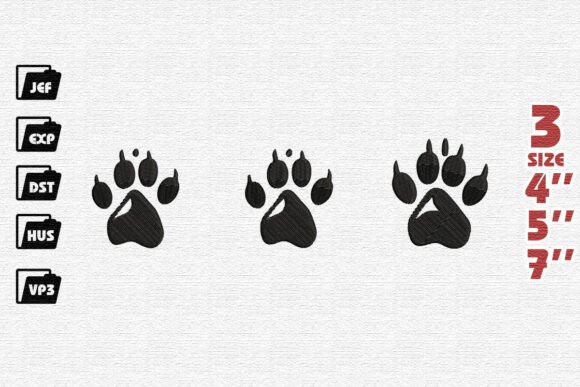
When I opened the Classic Paw Print Embroidery Design, my first thought wasn’t “cute” — it was “resolved.” Three identical paw prints, evenly spaced, no frills, no clutter. No hearts, no names, no cartoonish exaggeration. It’s quiet confidence in stitch form. That matters — especially when you’re stitching for real people who want sincerity over sentimentality. I immediately pictured it on a natural linen tea towel for a boutique kitchen line: simple, grounded, and unmistakably handmade.
Where This Design Earns Its Keep
The Classic Paw Print Embroidery Design thrives where subtlety and craftsmanship intersect. It’s ideal for custom apparel like lightweight sweatshirts or structured tote bags — fabrics that hold crisp detail without fighting the design. On a cotton apron for a local pet bakery? Perfect. On a baby onesie? Yes — but only if you use lightweight stabilizer and soft thread; the clean lines read clearly even at 2.5 inches wide. As an embroidered patch sewn onto denim jackets or canvas backpacks, it holds up beautifully — no satin-stitch bleeding, no fill-stitch pilling after washing.
I tested it on a mid-weight cotton twill cap — tricky terrain, with its curved surface and tight hoop access. The design adapted well because it avoids tight corners, dense fill areas, or fine interior details that buckle on convex surfaces. It also scales down cleanly: at 1.75 inches wide, all three paw prints remain distinct, legible, and balanced — a rarity among generic animal motifs. That makes it unusually versatile for Etsy sellers offering personalized gifts across age groups and product types.
Real-World Fit: From Nursery to Neighborhood Shop
Last week, I used the Classic Paw Print Embroidery Design on a set of organic cotton pillow covers for a small shop launching a “quiet joy” home collection. Customers responded strongly — not just to the theme, but to how *unforced* it felt. Unlike busier applique designs or overly stylized paw motifs, this one doesn’t shout. It invites recognition, not explanation. That builds trust: buyers sense intention, not algorithmic trend-chasing.
It also works quietly in commercial embroidery settings. For a local vet clinic’s staff sweatshirts, we stitched it in charcoal gray thread on heather grey fabric — professional, warm, cohesive. No need to add text or logos; the design carries weight on its own. And because it’s built around repetition (three identical elements), digitizing consistency is high — fewer surprises in stitch-out clarity across dozens of garments.
Where to Pause — Not Avoid, But Adjust
This isn’t a “set and forget” design on every surface. On highly textured fabrics — think bouclé knits or heavy terry cloth — the running-stitch outlines can blur unless you increase stabilizer support or reduce top tension slightly. On thin or stretchy fabrics (like jersey baby bodysuits), test stitch density first: too much fill stitch can cause puckering, especially between paw pads. And while it reads well on dark fabric, avoid ultra-low-contrast thread pairings — a light ecru thread on navy denim loses definition unless you add a subtle underlay.
Don’t force it into tiny hoops (<2.5" diameter) without checking spacing. Though compact, the three-paw layout needs breathing room. Crowding them risks thread jumps or inconsistent satin edges. Also skip using it as a standalone accent on curved brims or deep-seamed areas of caps — the symmetry works best on flat or gently contoured surfaces.
Design Integrity Meets Business Sense
For craft business owners and Etsy sellers, the Classic Paw Print Embroidery Design adds quiet value. It photographs well in printable mockups — clean lines translate reliably to digital previews, reducing customer questions about scale or clarity. It pairs effortlessly with minimalist branding: no reworking needed to match a neutral palette or modern typography. And because it’s rooted in the Wild Animals category without leaning into novelty or kitsch, it stays relevant beyond seasonal spikes — think holiday embroidery, yes, but also everyday nursery decor or wedding favors for pet-loving couples.
More importantly, it supports professionalism. When customers receive a finished product featuring this design — whether a custom embroidered tote bag or a baby embroidery set — they don’t question the maker’s skill. They notice restraint, balance, and care. That perception lifts perceived value, encourages repeat orders, and strengthens word-of-mouth referrals.
Practical Designer Notes Before You Stitch
- Always test the Classic Paw Print Embroidery Design on scrap fabric matching your final project’s weight and weave — especially for custom apparel or baby embroidery.
- Check stitch density: If your machine flags high-density zones, consider lightening the fill or adjusting underlay — this design shouldn’t need aggressive density to read clearly.
- Confirm hoop size compatibility before production runs. Even simple layouts can exceed standard 4x4 boundaries depending on spacing.
- Review small details in black-and-white mockups — contrast matters more than color for readability on varied backgrounds.
- Use appropriate stabilizer: tear-away for stable wovens, cut-away for knits or items needing durability through washes.
- Verify licensing terms before selling finished items or bundling the digital embroidery file — commercial use rights aren’t implied by category alone.
- Compare thread colors across light and dark fabric swatches — matte cotton threads often outperform glossy poly on natural fibers.
The Classic Paw Print Embroidery Design won’t win awards for complexity — and it shouldn’t have to. Its strength is in what it doesn’t do: it doesn’t distract, overcomplicate, or date quickly. For makers building a catalog of thoughtful, wearable, giftable handmade products, it’s not filler. It’s foundation.