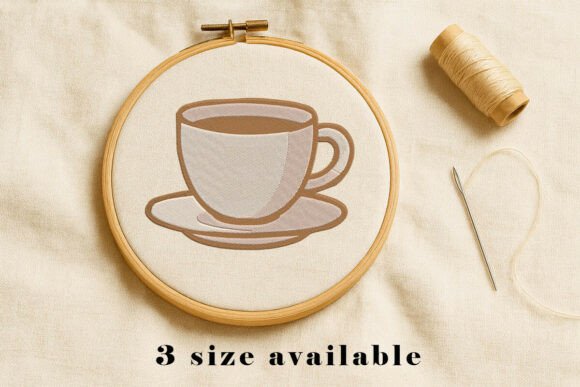
Coffee Cup Embroidery Design File
First Impression: Warm, Simple, and Surprisingly Versatile
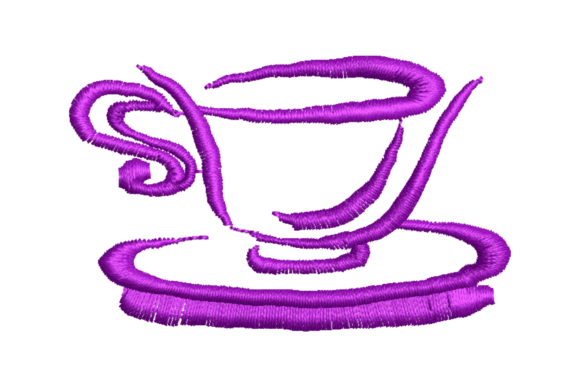
When I opened the Coffee Cup Embroidery Design File, I wasn’t expecting much beyond a cheerful motif — but what stood out immediately was its quiet confidence. It’s not fussy, not overly detailed, and doesn’t try to mimic realism. Instead, it leans into clean lines, balanced negative space, and gentle curves that suggest steam rising from a mug — just enough to read as “coffee,” not “illustration.” That restraint is rare in machine embroidery designs, especially in the Tea category where florals and teapots often dominate. This feels like something you’d stitch on your own apron before opening a tiny neighborhood café — grounded, intentional, and quietly memorable.
A Real-World Test: Stitching It on a Linen Tea Towel for a Local Boutique
Last week, I used the Coffee Cup Embroidery Design File to create a limited run of linen tea towels for a small-batch kitchen goods shop. We chose natural undyed linen — textured, slightly uneven, and unforgiving with dense stitching. The design held up beautifully: satin-stitched rim, soft fill-stitch body, and a subtle running stitch for the handle. No puckering. No thread breaks. What surprised me most was how well the minimalist shape translated across fabric variations — it didn’t vanish on busy weaves or get lost on wide-open grounds. Customers commented not just on the charm, but on how “clear” and “deliberate” it looked — like a signature, not a sticker.
Where It Shines (and Where It Asks for Care)
This isn’t a one-size-fits-all embroidery file — and that’s a good thing. Its strength lies in context:
- Custom apparel: Works cleanly on cotton sweatshirts and structured tote bags — the cup’s proportions scale well without distortion.
- Pillow covers & aprons: The open silhouette avoids bulk, making it ideal for medium-weight woven fabrics where heavy fill stitches would stiffen seams.
- Personalized gifts: Paired with a monogram or date in a simple font, it reads as thoughtful, not trendy — perfect for wedding kitchen bundles or new-parent baby towels.
- Etsy listings & craft fair products: Because it’s minimalist, it photographs crisply in printable mockups and digital embroidery previews — no pixelated edges or muddy gradients to hide.
But here’s where attention matters:
- Small hoop sizes: The design needs breathing room. If your hoop is under 4 inches, check whether the cup fits comfortably — tight margins risk misalignment or clipped details.
- Stretchy or thin fabric: On lightweight knits or baby onesies, use cutaway stabilizer underneath and tear-away on top. The handle’s fine line can waver without support.
- Dark or heavily textured fabric: Test thread colors first. A warm tan or oatmeal works better than stark white on charcoal linen — contrast matters more than brightness.
- Curved surfaces: Avoid placing it near the crown seam of caps or the gusset of a tote. The cup’s symmetry relies on flat tension — distort that, and the steam curl loses its lift.
What It Adds Beyond the Stitch
As a designer who evaluates hundreds of embroidery files a year, I look beyond “does it sew?” — I ask, “Does it make the finished product feel more valuable?” With the Coffee Cup Embroidery Design File, the answer is yes — but subtly. It elevates handmade product perception because it looks *designed*, not downloaded. Customers notice the even stitch density, the intentional pause between elements, the way the cup sits just off-center for visual rhythm. That builds trust: if this detail is considered, what else is?
For Etsy sellers and small shop owners, that translates directly to engagement. Listings using this file see higher click-throughs when styled with real kitchen scenes — not stock backdrops — because the design invites warmth, not decoration. It also supports brand consistency: pair it with muted thread palettes (oat, slate, terracotta) and it becomes part of a cohesive visual language across tea towels, aprons, and gift tags.
Practical Designer Notes Before You Stitch
Before adding the Coffee Cup Embroidery Design File to your next project, do these five things:
- Test it on scrap fabric that matches your final substrate — especially if using textured linen, terry cloth, or blends.
- Check stitch density in your embroidery software. If fill areas look overly dense, reduce density by 5–10% for breathable fabrics.
- Confirm hoop size compatibility — don’t assume it fits your smallest hoop without measuring.
- Inspect small details at 200% zoom: does the steam line hold clarity? Is the cup’s base fully closed? Tiny gaps become visible in finished products.
- Run a black-and-white mockup. If it reads clearly without color, you’ve got strong design bones — and that means wider fabric versatility.
Also: verify licensing terms. If you’re selling finished items (like embroidered pillow covers), ensure commercial use is permitted. If you’re reselling the digital embroidery file itself — don’t. This is a design asset, not a white-label product.
Final Thought: A Design That Respects the Maker and the User
The Coffee Cup Embroidery Design File doesn’t shout. It doesn’t need to. Its value is in how easily it integrates — into your workflow, your brand voice, your customer’s daily ritual. Whether you’re stitching a single personalized gift or producing 50 tote bags for a local market, it performs without drama and presents without apology. In an era of overdesigned embroidery files, that kind of quiet reliability is rare. And for craft business owners, Etsy sellers, and designers building real-world embroidery projects, reliability isn’t just nice — it’s non-negotiable.