Paper Plane Embroidery Design File
A Minimal, Imaginative Anchor for Your Craft Fair Booth
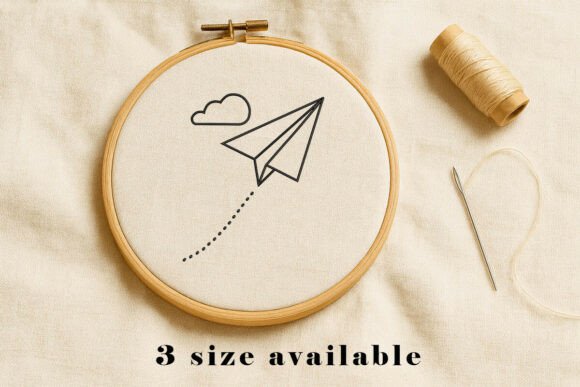
As an embroidery designer who’s prepped over 200 craft fair tables—and watched which designs stop shoppers mid-aisle—I opened the Paper Plane Embroidery Design File expecting lightness. What I got was more: a clean, confident minimalism that feels both nostalgic and quietly modern. It’s not cute or whimsical in a sugary way—it’s thoughtful. The flying paper plane against a subtle cloud background reads as imagination, freedom, and gentle optimism—qualities that resonate deeply with parents, educators, creatives, and gift buyers browsing handmade markets. It lands firmly in the “minimal but meaningful” sweet spot—not too literal, not too abstract. That balance is rare, and it’s why this design has strong legs across multiple product categories.
Where It Shines on Real Craft Fair Products
This machine embroidery design thrives where simplicity meets storytelling. On a natural canvas tote bag? Instant charm—especially when placed off-center near the bottom hem. It reads clearly from six feet away, doesn’t overwhelm the fabric, and invites conversation (“Oh—my kid folded one just like that!”). As apron embroidery, it works beautifully above the pocket or centered on the bib: small enough to feel intentional, large enough to hold presence. For tea towel embroidery, it pairs perfectly with linen or unbleached cotton—no competing patterns needed. The cloud background adds soft visual weight without heaviness, making it ideal for textured towels where dense stitch areas might otherwise blur.
As an embroidered patch, the Paper Plane Embroidery Design File excels. Its clean lines translate crisply at 2.5–3 inches wide, and the minimal detail holds up through laundering and repeated iron-on application. On caps? Use it on the front panel—but only if your hoop size accommodates the curve comfortably. Test first: tight curves can distort thin wings or soften cloud edges. For fabric pouches and pillow covers, it anchors the design without demanding attention—making it a smart choice for coordinated sets (e.g., matching pouch + tea towel + apron). And yes—it’s a standout small shop product for baby showers, teacher gifts, or “graduation starter kits.” Its association with Toys is subtle but effective: it hints at play, growth, and possibility—not plastic or noise, but quiet creativity.
What Makes It Sell—And What Requires Care
The Paper Plane Embroidery Design File earns its place in your lineup because it’s instantly legible, emotionally resonant, and commercially versatile. At a glance, customers understand it—no decoding, no squinting. That’s gold for craft fairs, where attention spans are measured in seconds. It scales well: use it small (1.75”) as an accent on a market bag tag, or larger (4”) as a focal point on a pillow cover. Photographs cleanly for Etsy seller listings—no busy background needed. And because it’s low-detail and open-spaced, it’s highly repeatable for batch production. No rethreading every third piece. No stabilizer surprises—if you’ve embroidered a basic monogram, you’re ready.
But here’s where care matters: avoid cramming it onto thick, napped fabrics like heavy denim or sherpa without testing stitch density and stabilizer pairing. Tiny wingtips and delicate cloud outlines may vanish on dark fabric unless you choose high-contrast thread colors (think white or pale sky blue on charcoal). On curved surfaces—like baseball caps or rounded pouch seams—verify that the design’s proportions hold. And never skip the scrap-fabric test: run it on the exact fabric you’ll use, with your intended stabilizer and thread. That’s the only way to catch subtle crowding or float issues before stitching 50 tote bags.
Design Strengths That Build Your Brand
This isn’t just another digital embroidery file—it’s a brand amplifier. Its minimal aesthetic reinforces handmade quality and intentionality. In a booth full of floral wreaths and rustic quotes, the Paper Plane Embroidery Design File stands out by being different without being difficult. It signals sophistication, calm, and creative confidence—traits your ideal customer associates with premium handmade product. When paired consistently across your line (e.g., same thread palette on totes, aprons, and patches), it builds instant recognition. Buyers remember the feeling—not just the object. That’s how a simple paper plane becomes part of your story.
Practical Designer Notes Before You Stitch
- Always test the Paper Plane Embroidery Design File on scrap fabric—same weight, weave, and color as your final product.
- Check thread contrast early: light threads on light fabric often lack definition under fair lighting.
- Review spacing between plane and cloud elements—if they’re too tight, consider slight manual adjustment for breathability.
- Confirm your hoop size matches the design’s maximum dimension—don’t force a 5” design into a 4” hoop.
- Inspect stitch density: look for overlapping satin stitches or overly dense fill areas that could cause puckering on lightweight cotton.
- Choose your stabilizer intentionally—tear-away for stable wovens, cut-away for knits or stretchy pouch linings.
- Create at least one real mockup, not just a printable mockup. Fabric drape, texture, and light change everything.
- Compare how it looks on multiple fabric colors: oatmeal, slate, cream, and navy each tell a different version of the same story.
- Verify commercial licensing before selling finished products—this is non-negotiable for commercial embroidery use.
The Paper Plane Embroidery Design File won’t shout. But it will linger—in memory, in photos, in the quiet satisfaction of a buyer who chose something that feels both personal and timeless. That’s not just embroidery. That’s connection, stitched.